You Asked About a Roth Conversion. The Answer Might Be an Income Plan.
The call usually starts the same way.
Someone read something about Roth conversions. Maybe they saw one of our posts. Maybe their neighbor did one. They call, and the first thing they say is: "I think I need to do a Roth conversion."
Sometimes they're right.
But a fair number of the time, twenty minutes into looking at their actual numbers, we end up somewhere completely different. Not because the Roth conversion was a bad idea — because it was an answer to a question they hadn't asked yet.
Here's how to tell which one you are, before you spend money finding out.
Two different questions
A Roth conversion answers this: how do I owe less tax later?
You move money from a traditional IRA to a Roth. You pay the tax now, at a rate you can see, instead of later at a rate you can't. It grows tax-free. There are no required distributions. Your heirs receive it without a tax bill attached.
That's a real strategy and for the right person it's worth six figures.
An income plan answers a different one: how do I know the money doesn't run out?
You have a balance. You need a paycheck. Something has to convert one into the other, reliably, for as long as you live — through a market crash, through a bad decade, through living longer than the plan assumed.
Both are good questions. They are not the same question.
And here's the part that matters: the second one usually has to be answered first.
Why the order isn't optional
A conversion strategy built on top of an income plan that doesn't work is a well-optimized way to run out of money in a lower tax bracket.
Think about what a conversion actually does in the short run. You voluntarily create taxable income in a year you didn't have to. You write a check to the IRS. Your account balance goes down by the amount of that check.
If your income floor is solid, that's a smart trade — you're buying decades of tax-free growth at a known price.
If your income floor is not solid, you just made it worse. You reduced the pile you're depending on, to save taxes on money you may need to spend before those savings ever show up.
Same strategy. Opposite outcome. The only variable is whether the floor was there first.
Do the floor math — it takes ten minutes
You don't need software for this. You need three numbers.
1. What do your fixed expenses actually cost?
Not your budget. Not what you'd like to spend. The bills that arrive whether the market is up or down: housing, insurance, utilities, food, medical, transportation.
Write it down. Most people have never written it down, and the number is almost always different from what they guessed.
2. What income is already guaranteed?
Social Security. A pension, if you have one — including a FERS or CSRS annuity. VA disability, which is tax-free and doesn't even count toward the calculation that makes Social Security taxable.
These are pensions. They already exist. They arrive whether or not the market cooperates.
3. Subtract
| Fixed expenses | $58,000 |
| Social Security | $42,000 |
| The gap | $16,000 |
That's about $1,333 a month, and it's the entire problem. Not the $58,000. Not the whole portfolio. Just the gap.
For most people this number is much smaller than they feared, and that's usually the first good news in the conversation.
Everything else you own is now free to do a different job. Once the gap is covered by something that can't stop, the rest of the portfolio doesn't have to fund groceries during a downturn. It can be invested for growth, or converted to Roth, or left alone.
Now stress-test it against 2032
This is the step almost nobody takes, and it changes the answer.
Social Security's retirement trust fund is projected to run short in the fourth quarter of 2032. At that point incoming payroll taxes cover 78% of scheduled benefits — a 22% cut, unless Congress acts.
Run the same household again with that assumption:
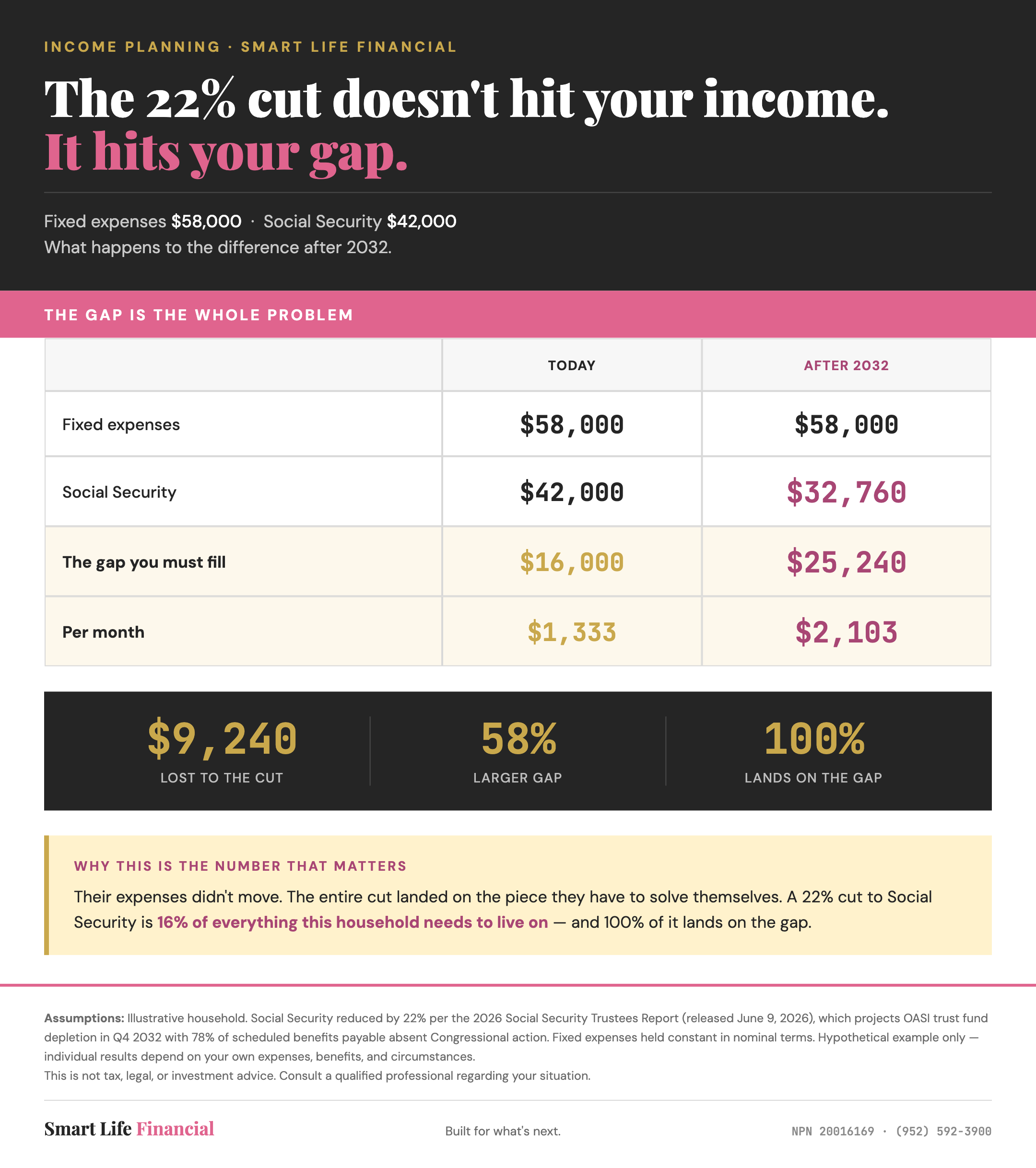
Their expenses didn't change. Their Social Security dropped $9,240. And the entire cut landed on the gap.
The gap went from $16,000 to $25,240 — 58% larger. From $1,333 a month to $2,103.
That's the real math of the 2032 problem, and it's why "a 22% cut" understates it for anyone relying on Social Security to cover essentials. The cut is 22% of the benefit, but for this household it's 16% of everything they need to live on — and 100% of it lands on the piece they have to solve themselves.
A plan built on today's Social Security statement is a plan with an expiration date printed in a federal report.
Signs you're an income case first
- You're within five years of retiring, or already retired
- You don't have a pension covering your fixed expenses
- Your real fear is running out of money, not paying tax
- You'd have to pay the conversion tax out of the retirement account itself
- A 30% market drop in the next three years would change how you live
- Someone told you to "just take 4%" and it didn't feel like an answer
Signs a conversion comes first
- You're still working, or several years from needing income
- Your fixed expenses are already covered by a pension and Social Security
- You have money outside the retirement account to pay the conversion tax
- Your biggest identified risk is the tax bill on future required distributions
- You're planning around what your heirs receive more than what you spend
Most people are some of both. Almost nobody is purely one. Which is why the answer is rarely "conversion" or "income plan" — it's an order of operations, and the order is where the money is.
The thing nobody mentions: they compete for the same space
Here's a detail that surprises people, and it's the strongest argument for doing this in the right sequence.
Your Roth conversion room and your income-withdrawal room are the same room. You can't spend a dollar of bracket space twice.
Every dollar you convert fills up bracket space. So does every dollar you withdraw for living expenses. So does every dollar that drags more of your Social Security into the tax base. So does every dollar that pushes you across an IRMAA threshold and raises your Medicare premiums two years later.
Convert aggressively and draw income and trigger Social Security taxation and cross an IRMAA line in the same year, and you've spent one dollar of room four times over.
There's a right amount to convert in any given year. It's determined by what else is happening in that year. Which means you can't know it until you know what your income plan looks like.
That's the whole argument for sequence.
When the answer is "not yet"
Sometimes we run the floor math and the answer is: your pension and Social Security already cover your fixed expenses. You don't need an income product. What you need is a conversion strategy and someone to watch your bracket.
Sometimes it's the opposite: you're 63, the gap is real, and a conversion right now would take money you're going to need before the tax savings ever arrive. Convert later, in the low-income years after you retire and before required distributions start — age 73 if you were born between 1951 and 1959, or 75 if you were born in 1960 or later.
And sometimes the answer is that you're fine and should go enjoy your retirement.
We say all three. The plan drives the product, never the other way around, and sometimes the plan says don't buy anything.
Where to start
If you called about a Roth conversion and something in here made you pause — that's the right instinct. It doesn't mean a conversion is wrong for you. It means the conversation should start one step earlier.
Do the floor math yourself. Three numbers, ten minutes. Then run it again with Social Security 22% lower and see what happens to your gap.
If that number bothers you, that's worth a conversation before your next withdrawal, not after.
Start with a discovery conversation →
Or call (952) 592-3900. Twenty minutes, your actual numbers, and a straight answer — including "you don't need this" if that's the answer.
About the Author
Scott Borhauer
Scott Borhauer is the founder and principal advisor of Smart Life Financial, where he designs retirement income, tax, and estate strategies for federal employees, business owners, and pre-retirees. His work centers on the arithmetic most people never get shown — Roth conversion sequencing, Social Security timing, and the tax cost of doing nothing — and he coordinates with CPAs and estate attorneys to execute the plan, not just write it. Licensed insurance producer, NPN 20016169.
Retirement Income Planning Worksheet
Step-by-step worksheet to map out your income streams and find gaps in your plan.
📊 Free instant download · Unsubscribe anytime
Related Posts
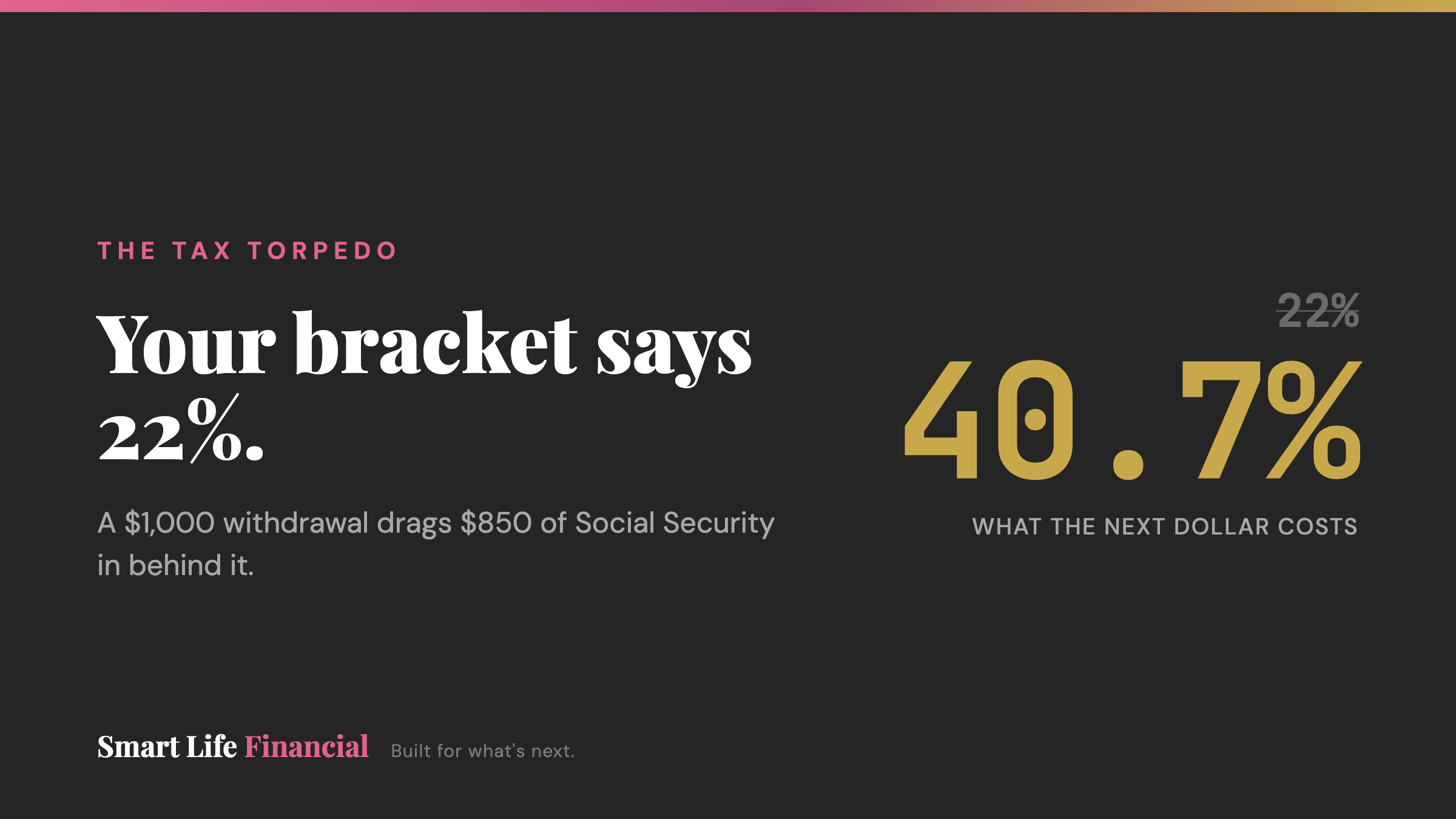
The Other Social Security Cut: The Tax Torpedo Explained
Social Security's taxation thresholds haven't moved since 1984. Here's how a $1,000 IRA withdrawal can cost 40.7% when your bracket says 22% — and what to do.
How a Discount Conversion Actually Works
A discount conversion is a legitimate application of ordinary valuation principles to an unusual asset — and five pressure tests that separate the real thing from the way it is often marketed.
Three Moves. Six Years. Tax-Free Forever: How a Roth Conversion Actually Works
Most people think a Roth conversion means one giant tax bill. It doesn't. Real math, plain English: a $303,000 IRA, a 25% day-one war chest, six bracket-sized years — and the one decision that separates good plans from great ones.