Three Moves. Six Years. Tax-Free Forever: How a Roth Conversion Actually Works
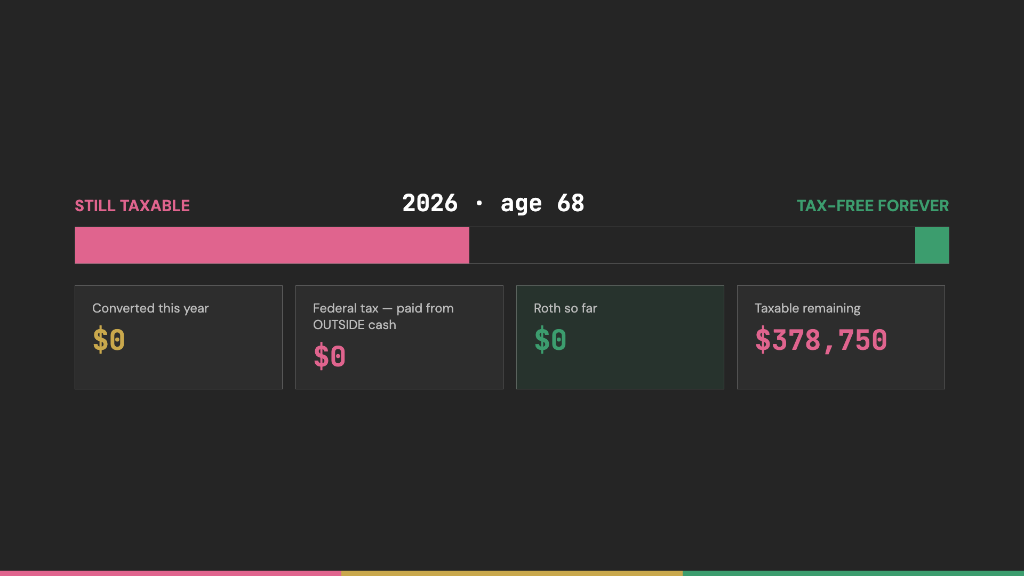
Most people think a Roth conversion means one giant tax bill — write the IRS a monster check, wince, done. That single misunderstanding keeps more families stuck in taxable retirement accounts than any other. So let's fix it, the way we always do: plain English, real math, nothing hidden.
We just published a 105-second animated explainer on our homepage that walks the whole strategy. This post is the written version, with the numbers on the table.
First, the problem nobody puts in plain English
Every dollar in a traditional IRA or 401(k) is still taxable. You built the account — but the IRS owns a share of it, and they decide when to collect. At age 73 (if you were born 1951–1959) or 75 (born 1960 or later), required minimum distributions force money out whether you need it or not. Those forced withdrawals can push you into higher brackets, make more of your Social Security taxable, and raise your Medicare premiums.
Your IRA is not just a retirement account. It's a tax liability with a timer on it.
The wrong mental model
The fear: convert everything in one year, pay top-bracket tax on the whole thing. That's not the plan. That's the mistake the plan exists to avoid. A conversion done right is a bridge crossed in small annual steps — each one sized to your tax bracket — with a war chest funding the tolls.
Here's the real example we animated, anonymized: a 68-year-old in Illinois with a $303,000 traditional IRA.
Move one: the transfer costs nothing
A direct IRA-to-IRA transfer moves the full $303,000 into a fixed indexed annuity. The money never touches his hands, so nothing is taxable on the move. The principal is protected — the account cannot lose value to a market downturn.
Move two: the war chest arrives on day one
The carrier credits a 25% premium bonus at issue: $75,750, bringing the contract to $378,750 before a single dollar converts.* That bonus is the war chest. It doesn't pay the tax — you do — but it offsets the tax cost of the entire conversion as you go. Watch how close the two numbers land below.
Move three: cross the bridge, one year at a time
Convert about $76,000 per year — sized so every converted dollar stays inside the 22% federal bracket. Blended effective rate across the whole plan: roughly 18%. The conversion finishes in about six years.
| Year | Age | Converted | Federal tax | Roth (end of year)** | Still taxable** |
|---|---|---|---|---|---|
| 2026 | 68 | $76,000 | $13,973 | $79,800 | $302,750 |
| 2027 | 69 | $76,000 | $13,973 | $163,590 | $241,888 |
| 2028 | 70 | $76,000 | $13,973 | $251,570 | $177,982 |
| 2029 | 71 | $76,000 | $13,973 | $343,948 | $110,881 |
| 2030 | 72 | $76,000 | $13,973 | $440,945 | $40,425 |
| 2031 | 73 | $42,446 | $6,591 | $507,561 | $0 |
Total converted: about $422,446. Total federal tax: about $76,456. Now look back at the war chest: $75,750. The day-one bonus offsets roughly 99% of the total tax cost of the plan — and it grows alongside the account the entire way.
And here's the part nobody explains: each year's conversion moves money from the traditional contract into a mirror Roth contract at the same carrier. Because the money never leaves the carrier, it is not a surrender — no surrender charge, no bonus recapture, no market value adjustment. And a conversion is not a distribution, so there is no 10% early-withdrawal penalty at any age.
The question that separates a good plan from a great one: who pays the tax?
Two options. Both satisfy the conversion. One costs more.
Option one — pay from inside the annuity. The withdrawal that pays the tax is itself taxable. So a $20,000 tax bill at the 22% bracket requires withdrawing $25,641 — the tax on the tax adds $5,641, and all $25,641 is money that never reaches the Roth. (On this carrier, paying from inside is only available starting in year two, within the contract's penalty-free allowance.)
Option two — pay from outside cash. $20,000 from savings, checking, or a non-qualified account. Exactly what's owed, zero gross-up, and 100% of every converted dollar lands in the Roth.
That's why the plan is built on outside cash — and why the war chest matters. You don't spend the bonus to pay the bill; it sits in the contract offsetting the cost, growing, while your outside dollars do the efficient work.
Where you end up
No RMDs. No forced withdrawals. Growth the IRS never touches again. Heirs receive it 100% tax-free. And depending on your state, the state tax on every conversion may be zero — Illinois, for example, exempts qualified retirement income entirely, which means $0 state tax on all six years of this plan.
Your numbers will look different
Different balance, different bracket, different state, different timeline. That's the point — this isn't a product off a shelf, it's a bridge built to your specs. Watch the 105-second version on our homepage, then let's run your numbers.
Start your Discovery Form: smartlifefinancial.com/discovery
Or call: (952) 592-3900
Built for what's next — starting with your next 30 years.
* The 25% bonus includes an optional enhanced bonus rider carrying a 0.95% annual charge during the surrender charge period. Bonus rates are locked at issue per the carrier illustration and are subject to a recapture schedule on early surrender. Products with premium bonuses may offer lower crediting rates than products without.
** Hypothetical example for illustration only, at a conservative 5% growth assumption and 2026 IRS single filer brackets (Rev. Proc. 2025-32). Balances are projections, not guarantees. Fixed indexed annuities are long-term insurance products; guarantees are subject to the claims-paying ability of the issuing carrier. This is not tax or legal advice — consult a credentialed CPA and review the full product illustration and disclosures before acting.
About the Author
Scott Borhauer
Scott Borhauer is the founder and principal advisor of Smart Life Financial, where he designs retirement income, tax, and estate strategies for federal employees, business owners, and pre-retirees. His work centers on the arithmetic most people never get shown — Roth conversion sequencing, Social Security timing, and the tax cost of doing nothing — and he coordinates with CPAs and estate attorneys to execute the plan, not just write it. Licensed insurance producer, NPN 20016169.
Retirement Income Planning Worksheet
Step-by-step worksheet to map out your income streams and find gaps in your plan.
📊 Free instant download · Unsubscribe anytime
Related Posts
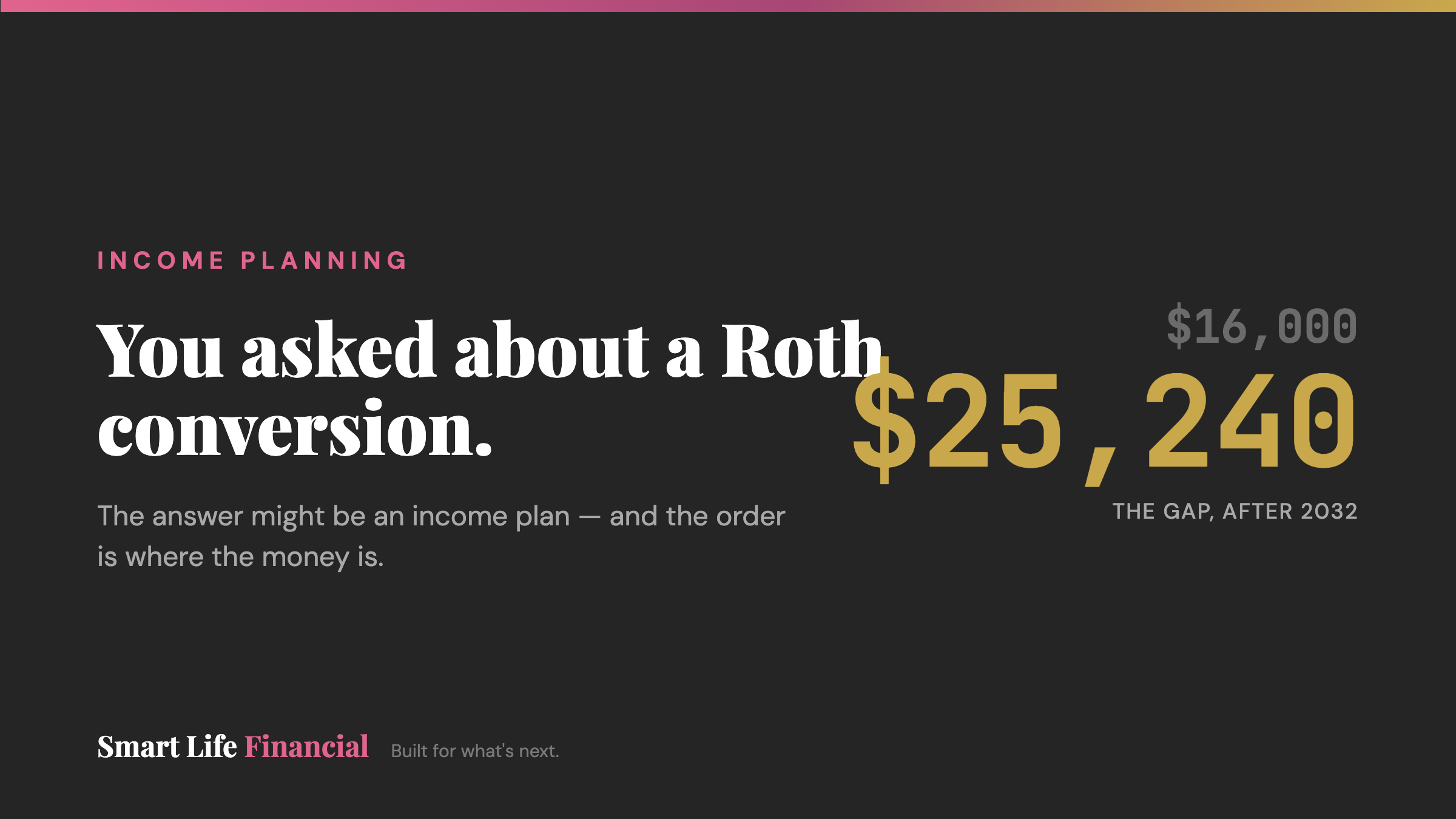
You Asked About a Roth Conversion. The Answer Might Be an Income Plan.
The call usually starts the same way — someone read about Roth conversions and calls saying they need one. Sometimes they're right. A fair number of times, the answer is an income plan, and the order is where the money is.
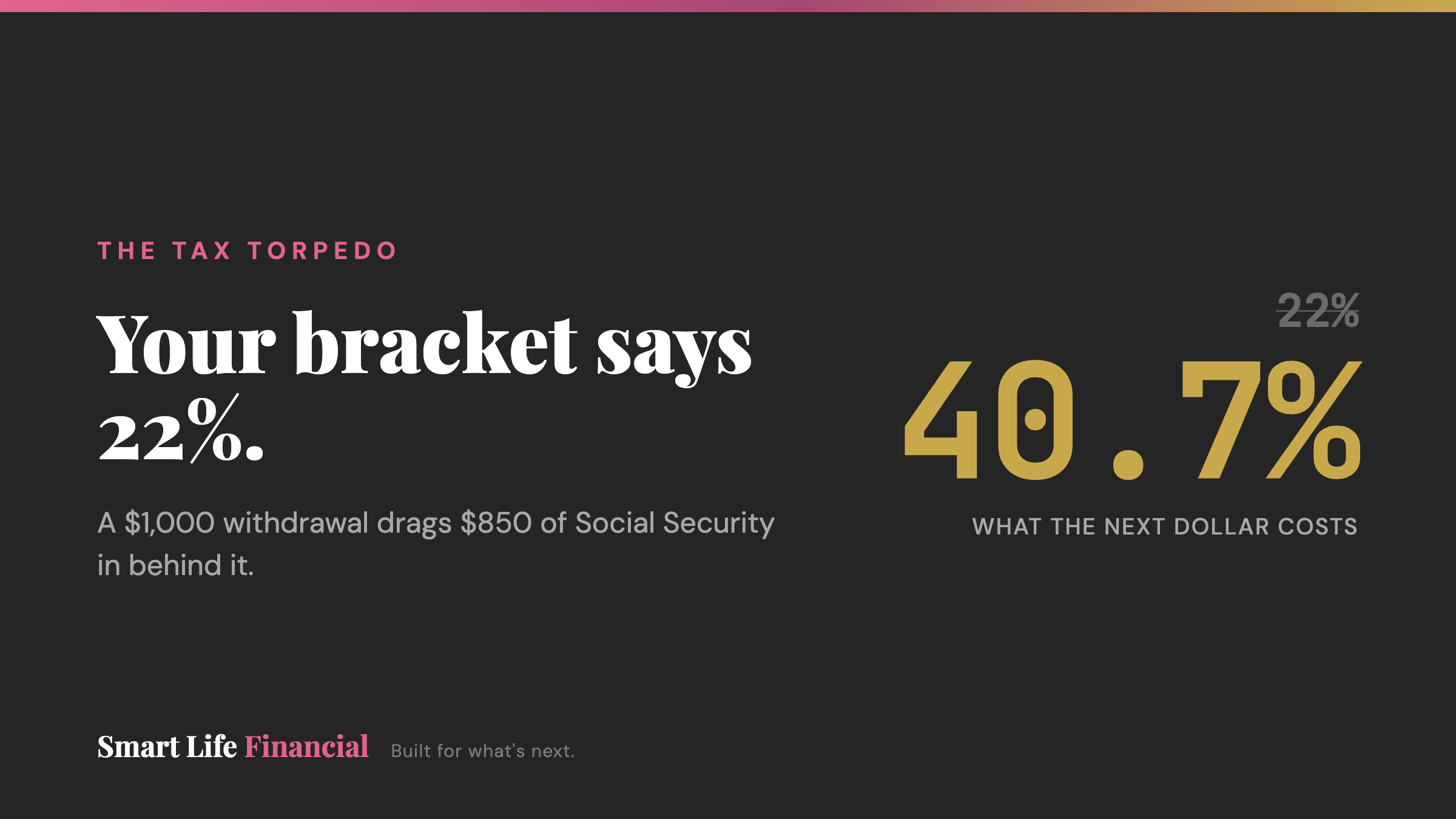
The Other Social Security Cut: The Tax Torpedo Explained
Social Security's taxation thresholds haven't moved since 1984. Here's how a $1,000 IRA withdrawal can cost 40.7% when your bracket says 22% — and what to do.
How a Discount Conversion Actually Works
A discount conversion is a legitimate application of ordinary valuation principles to an unusual asset — and five pressure tests that separate the real thing from the way it is often marketed.