Six Years and One Election: What the 2026 Trustees Report Says About Your Social Security
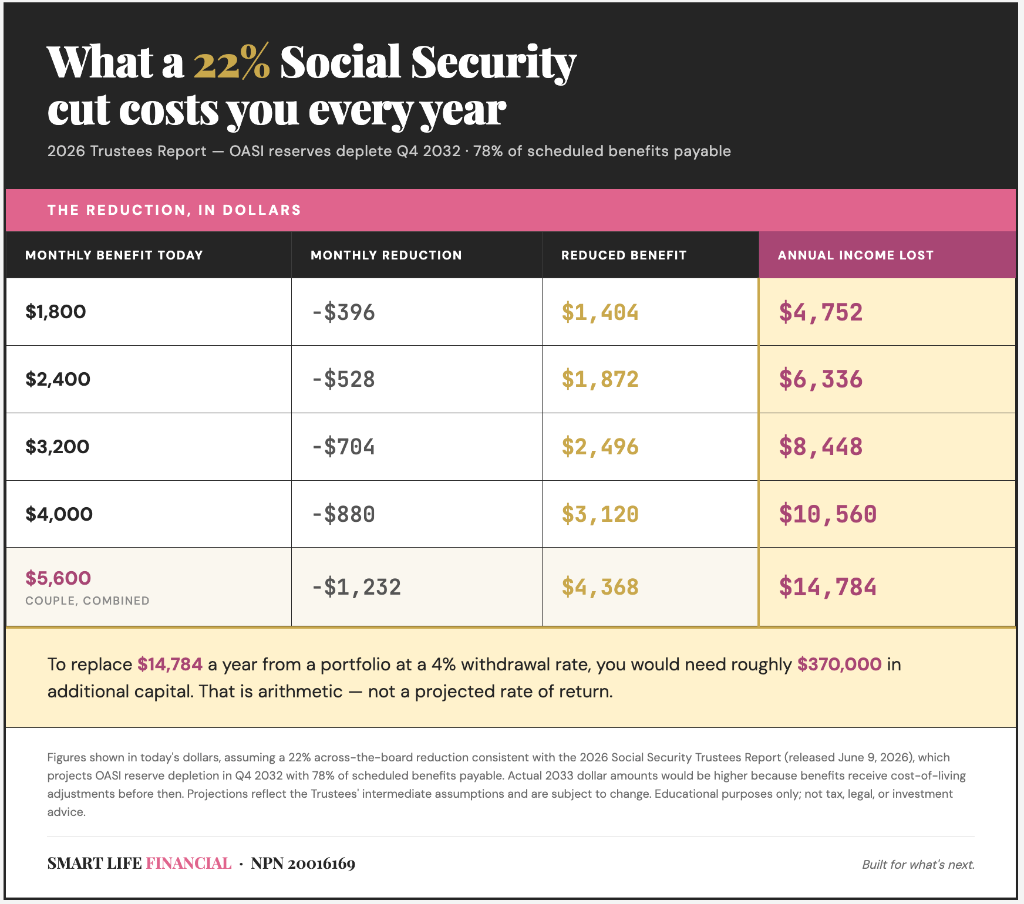
There's a line in the reporting this month that should stop you cold, and it has nothing to do with a percentage.
The senators Americans elect this November will still be in office when Social Security's retirement trust fund runs dry.
Not their successors. Not some future Congress. Them. The people whose names are on the ballot in about fourteen weeks.
For thirty years, "Social Security is running out of money" has been background noise — a thing people said at dinner parties that never seemed to arrive. It's arriving. And unlike every previous warning, this one now fits inside a single Senate term.
Let me show you the math, in plain English, and then let me tell you the honest part: what I know, what I don't, and what you can actually do about it.
The three numbers that matter
Everything else is commentary. These three come from the official 2026 Social Security Trustees Report, released June 9, 2026.
Number one: the fourth quarter of 2032.
That's when the Old-Age and Survivors Insurance trust fund — the one that pays retirement and survivor benefits — is projected to run out of reserves. About six years and three months from today.
The date moved up one quarter from last year's report. Two things pushed it: the 2025 tax law reduced the revenue Social Security collects from taxing benefits, and the Trustees revised their fertility and immigration assumptions downward. Fewer workers paying in, less tax revenue coming back.
Number two: 78 cents.
When the reserves are gone, the program doesn't shut down. It doesn't go bankrupt. Payroll taxes keep flowing in every two weeks from every working American, and those taxes keep funding checks.
They just don't fund full checks. The Trustees project that continuing income will cover 78 percent of scheduled benefits.
Number three: 22 percent.
That's the other side of 78. It's the automatic, across-the-board reduction that federal law requires if Congress does nothing. It isn't a proposal. It isn't a threat. It's arithmetic — the program is legally forbidden from spending more than it takes in, so when the cushion is gone, the checks get trimmed to fit the revenue.
It applies to everyone at once. Not just future retirees. People already collecting. Survivors. Dependents. Across the board.
Let's clear up the confusion you're about to hear everywhere
You are going to see two different sets of numbers in the press over the next six months, and they will make you think somebody is lying. Nobody is. They're measuring two different things.
When you see 2032, 78% payable, and a 22% cut — that's the OASI trust fund alone. The one that pays your retirement check. This is your number.
When you see 2034, 83% payable, and a 17% cut — that's OASI combined with the Disability Insurance fund. It is not your number, and combining those funds would require Congress to change the law. They are separate today.
So when a headline says "2034," check the fine print. It's almost always the combined figure — a hypothetical that assumes a law nobody has written. The number that governs your retirement check under current law is 2032.
One more you may run across: through 2025 and early 2026, several analysts published a 24 percent figure instead of 22. That was an estimate produced before the 2026 Trustees Report landed. Those same analysts have since re-run their numbers against the current report and now publish 22 percent. If someone quotes you 24, they're working from a stale file. We use 22.
This is the sort of thing we care about. If a number in one of our reports doesn't trace back to a primary source, it doesn't go in the report.
What 22 percent looks like at your kitchen table
Percentages are easy to shrug off. Dollars aren't.
A 22% reduction takes a $2,400 monthly benefit to $1,872 — a loss of $6,336 a year. A couple collecting $5,600 combined loses $14,784 annually.
Those are today's dollars. In actual 2033 dollars the numbers are larger, because benefits grow with cost-of-living adjustments between now and then. The Committee for a Responsible Federal Budget, working from the Chief Actuary's latest projections, estimates a typical dual-earning couple newly retiring at the start of 2033 would lose about $16,900 a year.
Now the second calculation, the one almost nobody runs.
How much capital would it take to replace that income?
Take the couple losing $14,784 a year. If you tried to replace that from a portfolio at a 4% withdrawal rate, you'd need roughly $370,000 of additional capital. At 5%, roughly $296,000.
That's not a market forecast and it isn't a promise about any product — it's division. $14,784 ÷ 0.04 = $369,600. I'm showing it because it reframes the whole conversation. A 22 percent haircut on Social Security isn't a small annoyance. For a typical retired couple, it's the equivalent of waking up one morning with a third of a million dollars missing from the balance sheet.
And unlike a portfolio, Social Security is inflation-adjusted and lasts as long as you do. Replacing it is harder than replacing a lump sum.
What changed this month
Here's the story underneath the story.
On July 14, a bipartisan group of eight senators — Cassidy, Durbin, Tillis, Kaine, Cornyn, King, Coons, and Armstrong — introduced S. 4979, the PROMISE Act.
The bill is unusual in that it doesn't propose a single change to your benefit. It proposes a process. It would task the Social Security Advisory Board — an existing independent, bipartisan body — with drafting a base reform bill and transmitting it to Congress, with a fast-track procedure to force an actual floor vote. And it would automatically trigger a fresh review any time the Trustees report the program is no longer on track to pay full benefits for at least fifty years.
Translation: it's an attempt to remove Congress's ability to do nothing.
Nine days later, AARP came out against it — objecting specifically to fast-tracking changes to Social Security without the ordinary committee process.
So within about ten days we got the first serious bipartisan mechanism for reform in forty years, and immediate opposition from the largest seniors' lobby in the country. Both of those things are reasonable positions. Neither of them is a plan you can build a retirement on.
The part where I tell you what I don't know
I don't know what Congress is going to do. Nobody does, and anyone who tells you otherwise is selling something.
What I can tell you is the shape of the problem, because it's constrained by arithmetic. To close the gap, Congress has four levers and only four.
Raise revenue. Lift or eliminate the payroll tax wage cap, or raise the 12.4% rate. Closing the OASI shortfall on the revenue side alone would take an immediate payroll tax increase of roughly 4.4 percentage points.
Reduce benefits. Raise the full retirement age, change the benefit formula, or means-test. Doing it on the benefit side alone means an immediate 22 percent cut — rising toward 38 percent by the end of the century.
Change the COLA. Switch to a slower inflation index. Small in year one, enormous over thirty years of compounding.
Tax more of the benefit. Push more of what you receive into taxable income.
Realistically it'll be a blend, and it'll be phased. The last time Congress fixed this — the 1983 Greenspan reforms — they raised the full retirement age from 65 to 67 and phased it in over decades. Almost nobody noticed at the time. Everybody retiring today feels it.
That's the pattern to expect: gradual, technical, and aimed at people who are further from retirement. Which means the closer you are to claiming, the more likely you are to be grandfathered — and the more your planning window is about tax structure rather than benefit structure.
So what do you actually do?
Three things. None of them require you to predict what Congress does.
One: find out what a 22 percent reduction does to your plan — not to the average household.
The average is meaningless. What matters is what share of your retirement income comes from Social Security. If Social Security is 25% of your income, a 22% cut is a 5.5% income hit — uncomfortable. If it's 70% of your income, the same cut is a 15.4% hit. That's a different life.
Run the sensitivity. Model your plan at 100% of scheduled benefits and again at 78%. If the plan works at 78%, you've made the reform question irrelevant to you, which is the whole goal. If it breaks at 78%, you now know exactly how big the gap is and you have six years to close it.
Two: build a floor that isn't legislative.
The vulnerability isn't Social Security itself. The vulnerability is concentration — having a large share of your guaranteed lifetime income come from a single source subject to a single act of Congress.
Diversifying the source of guaranteed income — not just the assets, the guarantee itself — is the structural answer. There are contractual ways to create income that lasts as long as you do and can't be legislated. They have costs and trade-offs, and we'll walk you through both honestly. But the principle holds regardless of which tools you use: don't let one vote in Washington determine whether your floor holds.
Three: take control of the one variable Congress has already told you about.
Whatever happens to your benefit, the taxation of your retirement income is a separate and largely controllable question — and the current window for restructuring it is unusually favorable and explicitly temporary.
That's the subject of our next post, and honestly it's where most of the recoverable money is.
The bottom line
Social Security is not going away. Anyone who tells you it will is either uninformed or trying to frighten you into a decision.
But under current law, on the Trustees' own projections, the retirement trust fund empties in the fourth quarter of 2032 and benefits drop to 78 cents on the dollar. Congress has about six years and one visible mechanism to change that outcome, and the mechanism just picked up an organized opponent.
You don't get a vote on the trust fund. You do get a vote on whether your retirement plan depends on it.
Run the 78% scenario. If your plan survives it, you sleep well for the next six years. If it doesn't, you have six years to fix it — and that is a lot more time than most people think they have.
Want your numbers run?
We'll model your plan at full scheduled benefits and at 78% side by side, using your actual earnings record and your actual retirement income sources — so you can see the gap in dollars instead of percentages.
Start here: smartlifefinancial.com/discovery
Prefer to talk it through first? Call (952) 592-3900. No pitch. We'll show you the math and you can decide what to do with it.
Scott Borhauer | Founder, Smart Life Financial | NPN 20016169
Built for what's next. Strategy for the world that's coming — not the one that's gone.
Sources. Social Security Board of Trustees, 2026 Annual Report, released June 9, 2026 — OASI reserve depletion projected for the fourth quarter of 2032, with 78 percent of scheduled benefits payable thereafter; combined OASI/DI depletion projected for the third quarter of 2034 with 83 percent payable, which would require a change in law to effect. Committee for a Responsible Federal Budget, analysis of the 2026 Trustees Report and benefit-cut estimates, July 16, 2026. Center for Retirement Research at Boston College. S. 4979, the PROMISE Act, introduced July 14, 2026.
Disclosure. This material is for educational purposes only and does not constitute tax, legal, or investment advice. Smart Life Financial is an independent insurance and financial planning firm; Scott Borhauer, NPN 20016169. Projections reflect the Trustees' intermediate assumptions and are subject to change. Legislation described is proposed and has not been enacted. Any guarantees referenced in connection with insurance products are backed solely by the claims-paying ability of the issuing insurance company. Consult your tax advisor and attorney regarding your specific situation.
About the Author
Scott Borhauer
Scott Borhauer is the founder and principal advisor of Smart Life Financial, where he designs retirement income, tax, and estate strategies for federal employees, business owners, and pre-retirees. His work centers on the arithmetic most people never get shown — Roth conversion sequencing, Social Security timing, and the tax cost of doing nothing — and he coordinates with CPAs and estate attorneys to execute the plan, not just write it. Licensed insurance producer, NPN 20016169.
Smart Life Financial Welcome Kit
Our best guides, checklists, and tools — all in one free download.
🎁 Free instant download · Unsubscribe anytime
Related Posts
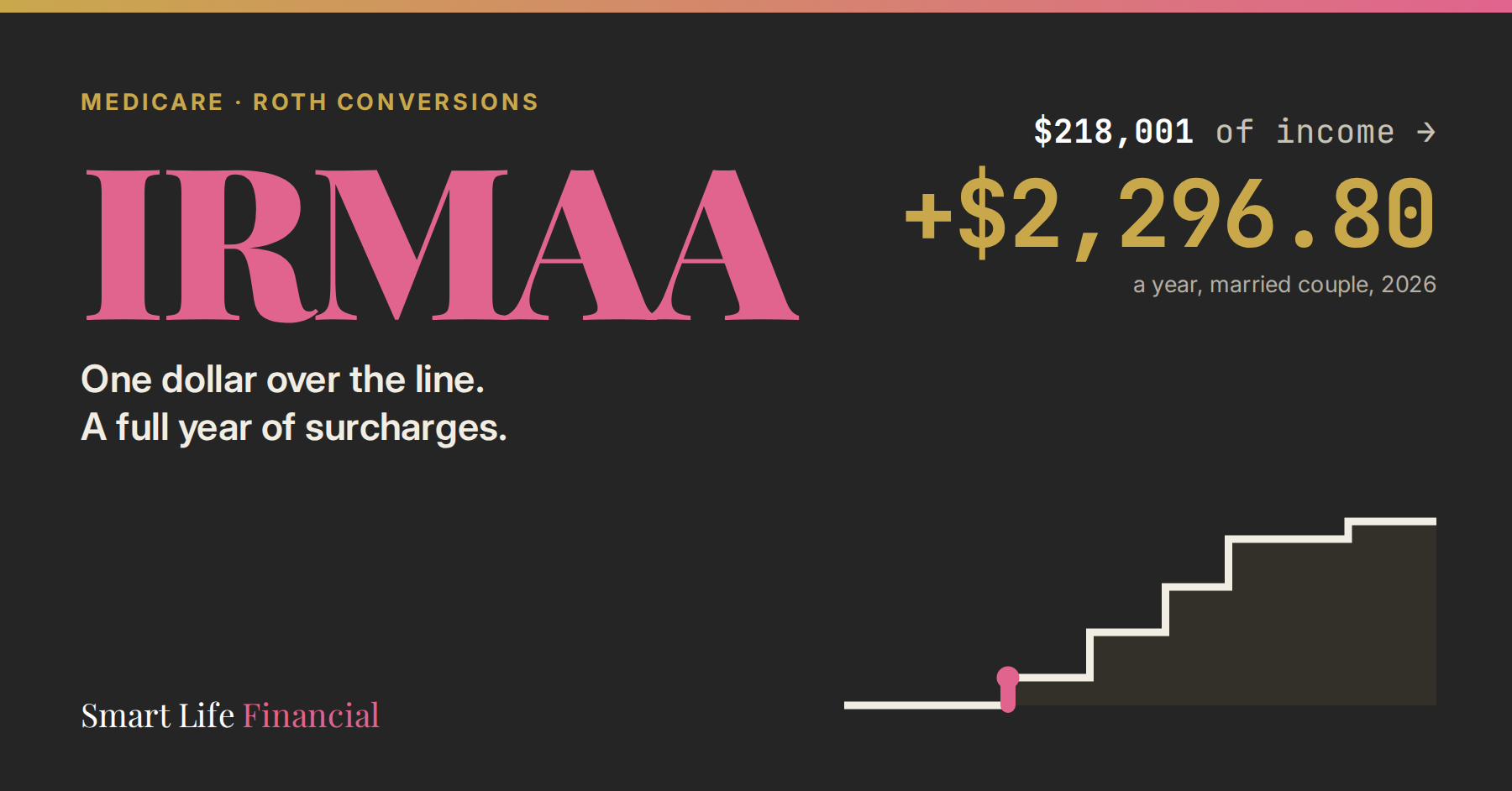
IRMAA and Roth Conversions: The $1 That Costs $2,296.80
One dollar over the line can add $2,296.80 to your Medicare premiums. See how IRMAA works with Roth conversions and how to size around the cliff.
The Augusta Rule: The Fourteen Days Are the Easy Part
How to set a rental rate you can defend, and what it's really worth in dollars.

You Asked About a Roth Conversion. The Answer Might Be an Income Plan.
The call usually starts the same way — someone read about Roth conversions and calls saying they need one. Sometimes they're right. A fair number of times, the answer is an income plan, and the order is where the money is.