The Other Social Security Cut: The Tax Torpedo Explained
Everyone is talking about the Social Security cut coming when the trust fund runs short.
Almost nobody is talking about the one that already happened — the one that is quietly taking money out of retirees' pockets right now, and takes a little more every single year.
It has a name. Planners call it the tax torpedo. And if you are retired with a pension, an IRA, or a 401(k) alongside your Social Security, there is a real chance you are sitting inside it and have no idea.
Here is the math.
Before 1984, Social Security wasn't taxed at all
Not a dollar of it. For every American who received it.
That changed with the Social Security Amendments of 1983, signed into law on April 20, 1983 and effective for the 1984 tax year. The Greenspan Commission recommended taxing benefits for higher-income retirees, and Congress agreed — with a catch.
Congress drew a line. Above a certain income, part of your Social Security becomes taxable income.
For single filers, that line was $25,000. For married couples filing jointly, $32,000.
A second, higher tier was added in 1993: $34,000 for singles, $44,000 for couples. Cross that one and up to 85% of your benefits become taxable.
At the time, these numbers were meant to reach only the wealthiest retirees. The Greenspan Commission estimated roughly 10% of beneficiaries would ever be affected.
The line has not moved since 1984
Not once. Not for inflation. Not for cost of living. Not at all.
This is the part that should bother you, because everything else in the tax code moves. Tax brackets adjust every year. The standard deduction rises every year. The Social Security payroll tax wage base rises with average wage growth. Your benefit itself gets a COLA.
The taxation thresholds sit exactly where Congress left them more than four decades ago.
Here is what that means in real terms. The Consumer Price Index averaged 103.9 in 1984. In April 2026 it stood at 332.4 — roughly 3.2 times higher.
| Threshold | Effective | Would be today if indexed |
|---|---|---|
| $25,000 — single | 1984 | about $80,000 |
| $32,000 — married filing jointly | 1984 | about $102,000 |
| $34,000 — single, 85% tier | 1994 | about $76,000 |
| $44,000 — married, 85% tier | 1994 | about $99,000 |
The 85% thresholds are measured from 1994, the year they took effect, which is why their adjustment is smaller — they had ten fewer years to erode.
A married couple with $102,000 of income today is standing in exactly the economic position that a $32,000 couple stood in when this law was written. The law treats them as wealthy. Nothing about their life says wealthy.
This is why a rule designed to catch the top 10% now catches roughly half of all Social Security recipients. The Social Security Administration's own projections put it at 52% of beneficiary families by 2015, climbing from there.
Nobody voted for that. It happened because a number stood still while the entire economy moved past it.
How the formula actually works
The IRS does not look at your Social Security check by itself. It looks at something called provisional income — also called combined income:
Provisional income = Adjusted Gross Income + tax-exempt interest + one half of your Social Security benefits
Read that last part again. Half of your Social Security counts toward the test that decides whether your Social Security gets taxed. Your benefit helps push you over the line that taxes your benefit.
Once you cross the first threshold, up to 50% of your benefits become taxable income. Cross the second, and up to 85% do.
Note the words up to. This is not a cliff where everything flips at once. It phases in — and the way it phases in is where the damage happens.
The torpedo: why your real tax rate is not your bracket
This is the part almost nobody explains, so let's do it with real numbers.
A married couple. $48,000 a year in Social Security. $40,000 a year from a traditional IRA.
Provisional income is $40,000 plus half of $48,000, which is $64,000. That is above both thresholds.
Running the calculation under Internal Revenue Code Section 86:
- 50% tier: half of the $12,000 sitting between $32,000 and $44,000 → $6,000
- 85% tier: 85% of the $20,000 above $44,000 → $17,000
- Taxable Social Security: $23,000 — about 48% of their benefits
Now watch what happens when they take one more thousand dollars out of the IRA.
That $1,000 pushes another $850 of Social Security into taxable income. So a $1,000 withdrawal creates $1,850 of new taxable income.
| Their tax bracket | Tax on that extra $1,000 | Real marginal rate |
|---|---|---|
| 12% | $222 | 22.2% |
| 22% | $407 | 40.7% |
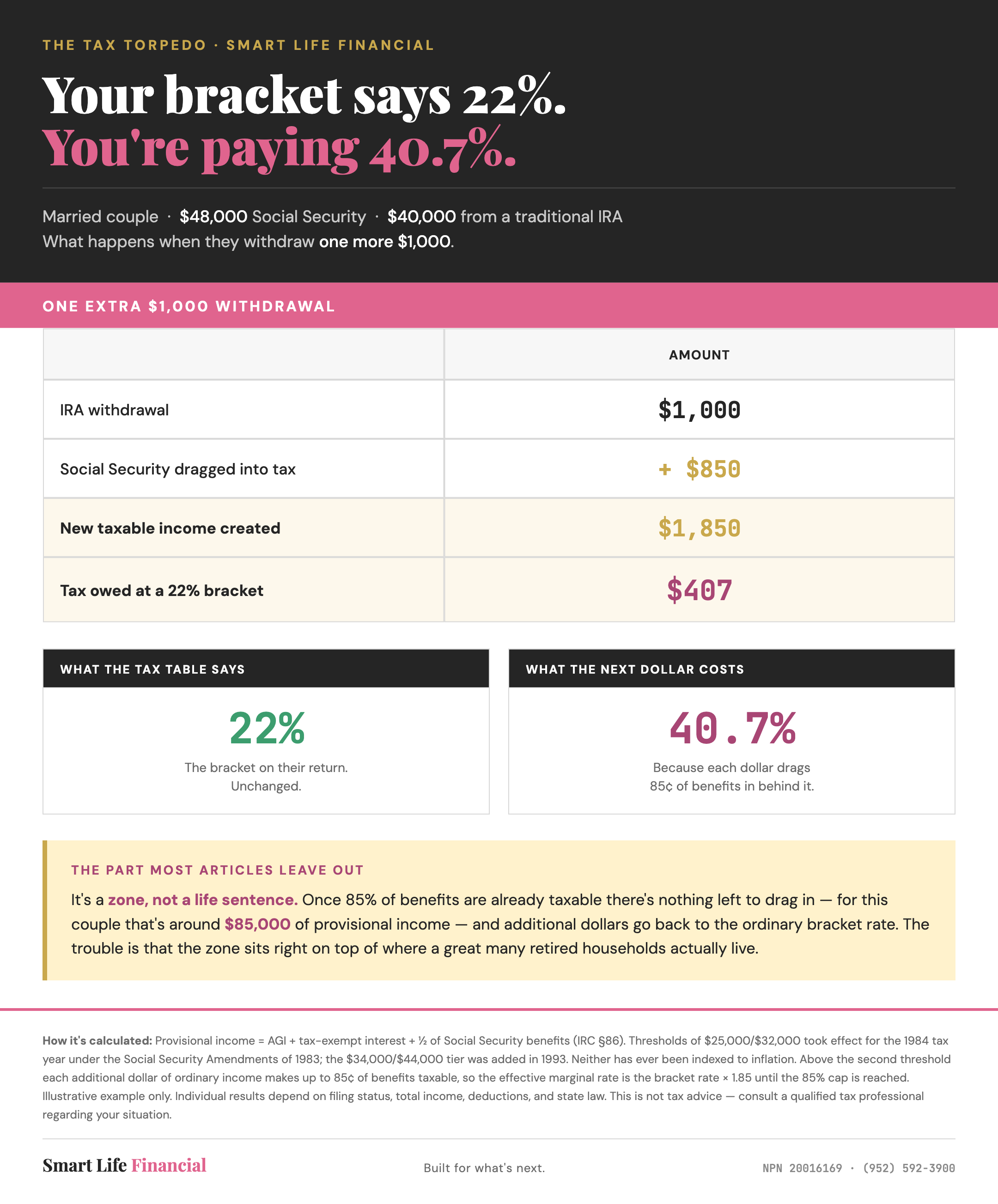 |
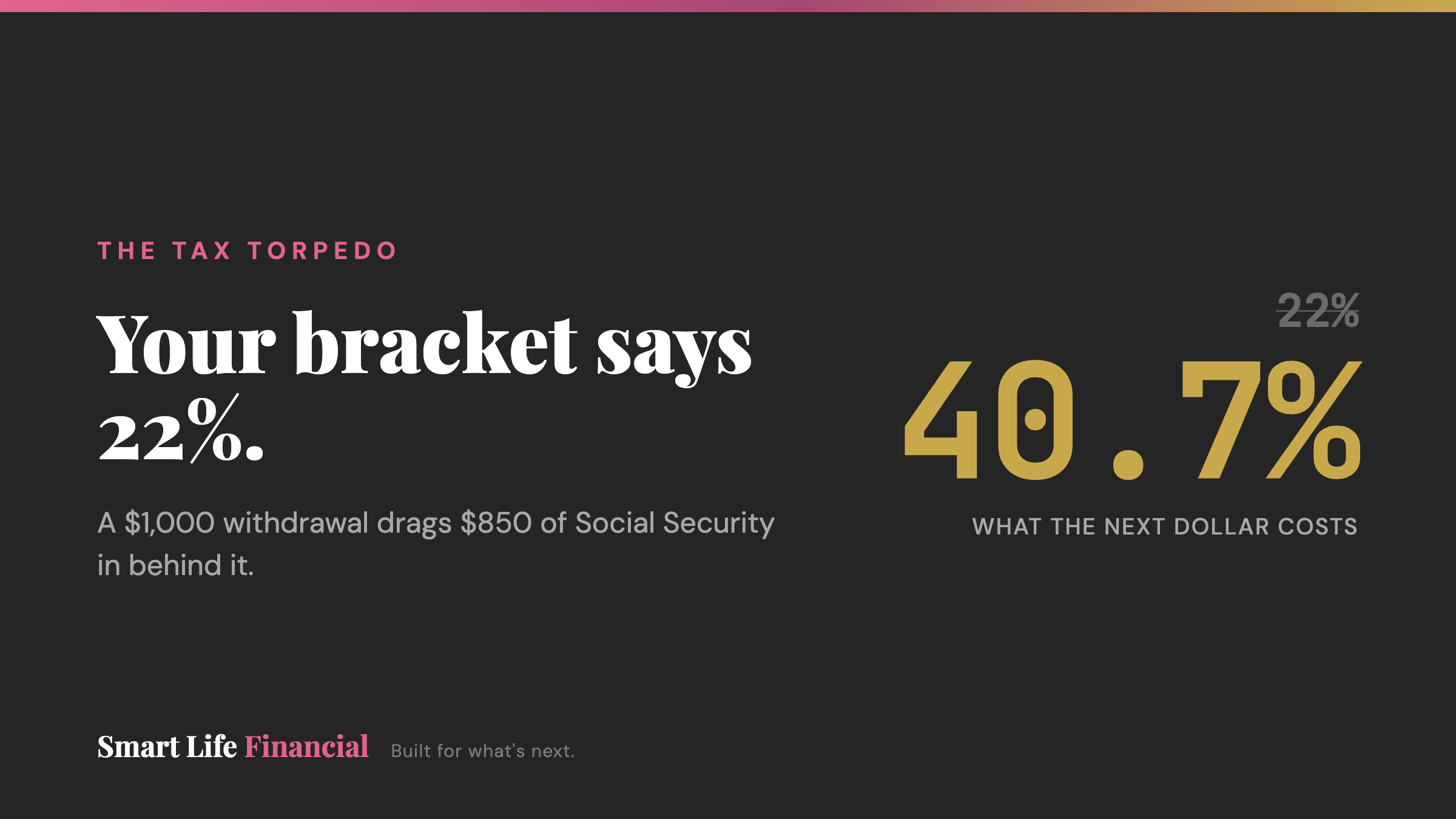
A couple who believes they are in the 22% bracket is handing over 40.7 cents of the next dollar they withdraw.
That is the torpedo. Their bracket did not change. Their tax return still says 22%. But the true cost of one more dollar of income is nearly double what the table says — because that dollar drags a second dollar of Social Security into the tax base behind it.
It is a zone, not a life sentence
Here is the caveat you will not find in most articles on this, and it matters.
The torpedo does not last forever. Once 85% of your benefits are already taxable, there is nothing left to drag in — the cap is reached. Additional income goes back to being taxed at your ordinary bracket rate.
For the couple above, that happens at roughly $85,000 of provisional income, or about $61,000 of IRA withdrawals.
So the torpedo is a zone. Below it, you are fine. Above it, you are back to normal. Inside it, your marginal rate is dramatically higher than you think.
The problem is that the zone sits squarely on top of where an enormous number of retired households actually live.
No, the 2025 tax law did not fix this
You may have seen headlines suggesting Congress eliminated tax on Social Security. It did not.
What passed was a senior deduction of $6,000 per person age 65 or older. It is a deduction against income — helpful, real money, and worth planning around.
But understand three things about it:
- It does not change the Section 86 rules. Provisional income is calculated exactly as it always was. The thresholds are still $25,000 and $32,000. The torpedo mechanics are untouched.
- It phases out as income rises, which creates its own separate marginal rate problem stacked on top of this one.
- It expires after the 2028 tax year. It covers 2025 through 2028 and then it is gone unless Congress acts again.
Anyone telling you Social Security is now tax-free is either misinformed or selling something.
What you can actually do about it
The torpedo is a math problem, and math problems have solutions. The reason most people never solve it is that solving it requires acting before the income shows up — not at tax time, when everything is already locked in.
Know where your line is. Run your provisional income. Find out whether you are below the zone, inside it, or past the cap. The answer changes every recommendation that follows, and most people have never had it calculated.
Understand that Roth dollars do not count. Qualified Roth distributions are not in the provisional income formula. Not the AGI portion, not anywhere. Money you move to a Roth today is money that cannot push your Social Security into the tax base for the rest of your life — or your spouse's.
Convert in the years before the income arrives. The window between retiring and the start of Required Minimum Distributions is often the lowest-income stretch of someone's entire adult life. It is also the last easy chance to move money out of the tax code. RMDs begin at age 73 if you were born between 1951 and 1959, or age 75 if you were born in 1960 or later — do not let anyone tell you it is simply "73."
Watch the order of withdrawals. Which account you draw from first can change how much of your benefit is taxed, sometimes by thousands of dollars a year, without changing your lifestyle by a penny.
If you are charitable, look at QCDs. A qualified charitable distribution from an IRA never enters AGI at all — which means it never enters provisional income either.
Model the second-spouse scenario. When one spouse dies, the survivor keeps most of the household income but files as single, against thresholds of $25,000 and $34,000 instead of $32,000 and $44,000. The torpedo gets worse at the exact moment life already got harder. This is the single most overlooked calculation in retirement planning.
The point
The 2032 cut is real, and we wrote about it separately. It is worth planning for.
But it is six years out and it requires an act of Congress to become final. The tax torpedo is here now. It has been taking money quietly for four decades, it takes slightly more every year that inflation moves and the thresholds do not, and there is no bill in front of Congress to stop it.
The good news is that this one you can actually do something about. The 2032 cut is out of your hands. This one is entirely in them.
If you want to know exactly where your line sits — and what it costs you to cross it — that is a conversation worth having before your next withdrawal, not after.
Start with a discovery conversation →
Or call (952) 592-3900.
About the Author
Scott Borhauer
Scott Borhauer is the founder and principal advisor of Smart Life Financial, where he designs retirement income, tax, and estate strategies for federal employees, business owners, and pre-retirees. His work centers on the arithmetic most people never get shown — Roth conversion sequencing, Social Security timing, and the tax cost of doing nothing — and he coordinates with CPAs and estate attorneys to execute the plan, not just write it. Licensed insurance producer, NPN 20016169.
Retirement Income Planning Worksheet
Step-by-step worksheet to map out your income streams and find gaps in your plan.
📊 Free instant download · Unsubscribe anytime
Related Posts
You Asked About a Roth Conversion. The Answer Might Be an Income Plan.
The call usually starts the same way — someone read about Roth conversions and calls saying they need one. Sometimes they're right. A fair number of times, the answer is an income plan, and the order is where the money is.
How a Discount Conversion Actually Works
A discount conversion is a legitimate application of ordinary valuation principles to an unusual asset — and five pressure tests that separate the real thing from the way it is often marketed.
Three Moves. Six Years. Tax-Free Forever: How a Roth Conversion Actually Works
Most people think a Roth conversion means one giant tax bill. It doesn't. Real math, plain English: a $303,000 IRA, a 25% day-one war chest, six bracket-sized years — and the one decision that separates good plans from great ones.