The tax on a conversion is not a question about your balance. It is a question about value.
Most people assume a Roth conversion works like a withdrawal. You move $500,000, you pay tax on $500,000. And when the account holds a mutual fund, that is exactly right — the fund publishes a price every afternoon and there is nothing to argue about.
But the rule is not "you pay tax on your balance." The rule is that you pay tax on the fair market value of what you converted, on the day you converted it. For anything with a public price, those two numbers are the same. For anything without one, they are not — and the gap between them is where this entire strategy lives.
That is not a loophole. It is the only workable rule. If your IRA holds a limited partnership interest in an apartment complex, there is no closing price. Somebody has to determine what it is worth. The tax code decides who, and how.
The standard is a hypothetical sale between two strangers
The governing framework is Revenue Ruling 59-60, written in 1954 for estate tax purposes and applied ever since to closely held and illiquid interests of all kinds. It asks one question: what would a willing buyer pay a willing seller, neither under any compulsion to act, both reasonably informed?
Read that again, because the whole thing turns on it. It is not asking what you paid. It is not asking what the sponsor's latest investor letter says the property is worth. It is asking what someone with no obligation to buy would actually hand you, in cash, today, for exactly the thing you hold.
And what you hold is usually not "an apartment building." What you hold is a minority slice of a partnership that owns an apartment building, which you cannot sell, cannot control, and cannot force to distribute anything. Those are different assets, and the second one is worth less than a pro-rata share of the first.
The two discounts, and what actually causes them
Two adjustments do almost all of the work.
Discount for lack of control. You own 4% of the partnership. You cannot fire the manager, cannot force a sale, cannot set the distribution schedule, cannot compel a refinance. A buyer stepping into your position gets no steering wheel. That is worth less than a slice that comes with one.
Discount for lack of marketability. You want out. Who do you call? There is no exchange. The partnership agreement probably requires the general partner's consent to transfer, may grant a right of first refusal, and may prohibit transfer outright for a period of years. Even a motivated buyer faces months of process and legal cost. That friction has a price.
These are not exotic. They are the ordinary furniture of business valuation, they appear constantly in estate and gift tax practice, and courts have been evaluating them for decades. Practitioners working in this area generally describe a defensible combined range of roughly 15% to 35% below the pro-rata value of the underlying assets, with lack-of-marketability discounts alone commonly cited in the 10% to 40% band depending on the specific restrictions in the documents.
Note what drives those numbers: the transfer restrictions in the partnership agreement, the size of the stake, and the absence of a market. Every one of those is a fact about the asset. Write that down. We come back to it.
The math, in plain English
Say the IRA holds a limited partnership interest whose pro-rata share of the fund's net asset value is $1,000,000. An appraiser reviews the operating agreement and concludes a 15% discount for lack of control and a 20% discount for lack of marketability are supportable.
You do not add the discounts. You apply them in sequence.
$1,000,000 × 0.85 = $850,000
$850,000 × 0.80 = $680,000
That is a 32% effective discount. Adding 15% and 20% to get 35% would produce $650,000 instead — understating the taxable amount by $30,000. The discounts compound against a shrinking base, not a fixed one, and an appraisal that adds them is an appraisal with an arithmetic error on its face.
At a 32% marginal rate:
| Converting at | Tax owed |
|---|---|
| Pro-rata NAV — $1,000,000 | $320,000 |
| Appraised value — $680,000 | $217,600 |
| Difference | $102,400 |
A hundred thousand dollars, and the same asset lands in the Roth either way. Everything it earns from that point forward — every distribution, the entire gain on eventual sale — comes out untaxed, to you or to your children.
That is a real and legitimate result. Now let me tell you the five ways it falls apart.
Pressure test #1: Who engaged the appraiser?
If the sponsor who sold you the deal also arranged the appraisal that produced the discount, you do not have an independent valuation. You have a marketing document with a number on it.
The appraisal is not paperwork. On examination, it is the defense. It should be prepared by a credentialed business appraiser your side engages and pays, it should identify its methodology, and it should reason from the specific transfer restrictions in your partnership agreement rather than recite generic language about illiquidity. A letter from the sponsor stating the value is unchanged does not meet the standard and never did.
Ask: Who selected this appraiser? Who pays them? What are their credentials? Will they defend this report under examination?
Pressure test #2: How long between the investment and the conversion?
This is the structural weakness, and it is the one promoters skip.
If your IRA writes a check for $1,000,000 on Tuesday and an appraiser certifies the interest is worth $680,000 five weeks later, the obvious question is why a willing buyer paid a million dollars for something worth six hundred eighty thousand. You cannot claim the willing-buyer standard for the second number and ignore it for the first.
Buy in at par, convert at a discount shortly after, and you have handed the IRS a step-transaction argument and an economic-substance argument at the same time. What defends against it is time, plus a real non-tax reason you made the investment in the first place — one you can articulate without mentioning the conversion.
Ask: How much time separates these two events? If I had never converted, would I still have wanted to own this? Can I say why, in writing, today?
Pressure test #3: Is anyone promising you 60%?
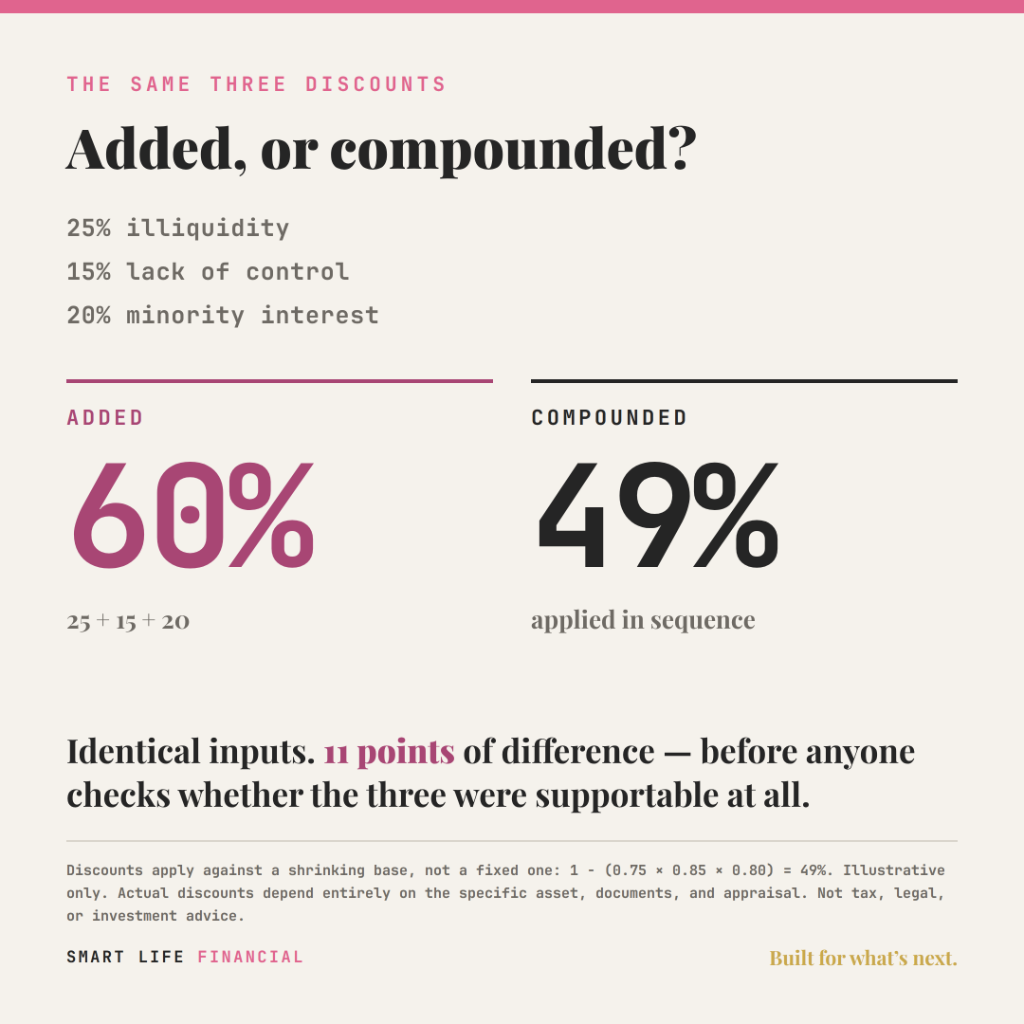
There is a 60% figure circulating in this corner of the market. Here is where it comes from.
Take three discounts — 25% for illiquidity, 15% for lack of control, 20% for minority interest — and add them. 25 + 15 + 20 = 60. Apply them properly, in sequence, and the same three inputs produce 49%.
So the number is inflated by eleven points before anyone examines whether those three inputs were supportable to begin with, or whether the third is just the first two wearing a different hat. A 60% discount is not the normal outcome of this strategy. It is the outer edge of the outer edge, arrived at through arithmetic that does not survive a second look.
And the penalty structure is unforgiving. IRC §6662 imposes a 20% accuracy-related penalty on an underpayment attributable to a substantial valuation misstatement, doubling to 40% where the misstatement is gross. Your custodian reports the account's fair market value to the IRS annually on Form 5498, and SECURE 2.0 expanded annual valuation reporting on illiquid IRA holdings — so the reported number, the appraised number, and the converted number all sit in the same file, and they had better agree.
Ask: What is the effective combined discount, computed multiplicatively? Is it inside 15–35%? If it is above that, what specific document provision justifies it?
Pressure test #4: Are the losses you are counting on actually usable?
This one costs people real money and almost nobody catches it in advance.
The common advice is to run the conversion in a year loaded with paper losses — bonus depreciation from a syndication, a cost segregation study, a heavy equipment purchase — and let the losses absorb the converted income. It sounds airtight. For most people it does not work.
A Roth conversion produces ordinary income. Losses from a real estate syndication where you are a passive limited partner are passive losses. Under IRC §469, passive losses offset passive income and nothing else. They cannot touch wages, business income, or a conversion. They suspend and carry forward, and your conversion is taxed in full.
There are exits, and they are narrow. Real estate professional status under §469(c)(7) requires more than 750 hours in real property trades or businesses and more than half your total working time. Short-term rentals where the average stay is seven days or less fall outside the rental definition entirely, but only with material participation. Working interests in oil and gas are carved out under §469(c)(3).
And even clearing that gate, a second ceiling waits. The excess business loss limitation under §461(l) was made permanent and the thresholds were reset downward: for 2026 they run roughly $256,000 for single filers and $512,000 for married filing jointly. Losses above the cap convert to a net operating loss, which can then offset only 80% of future taxable income — worth meaningfully less than a current-year deduction.
Ask: Are these losses passive or non-passive on my return? Which exception do I qualify for, specifically? What does Form 461 do to them?
Pressure test #5: Where does the tax money come from?
You just converted $680,000. You owe roughly $217,600 in April. Your Roth now holds an asset you cannot sell for years.
The tax has to be paid with cash from outside the retirement account. Paying it by pulling from the IRA defeats the entire exercise — you shrink the amount converted, and if you are under 59½ you add a 10% penalty to the withdrawal.
A few other things belong on this list. If you are of RMD age, the full required distribution must come out before any conversion happens. Leveraged real estate inside an IRA can generate unrelated debt-financed income, and a Roth does not shield you from it. Each conversion starts its own five-year clock for penalty-free access to converted principal.
Ask: Do I have the tax in cash, outside the plan, today? Not "will the deal distribute" — do I have it?
The one thing nobody assigns
There is a role in every version of this strategy that tends to go unfilled.
A self-directed custodian holds the asset. That is genuinely all they do — a directed custodian does not provide tax, legal, or investment advice, does not sponsor or sell investments, and does not endorse any investment or strategy. Their own paperwork says the account holder is solely responsible for the investment decision and for the due diligence behind it. That is not a gap in their service. It is what a passive custodian is, and it is the correct structure.
But it means somebody still has to select the investment, and somebody still has to value it. If you look around the table and cannot identify who owns each of those two jobs — by name — then the answer is you, and you will find that out later rather than sooner.
Prohibited transaction rules make that worse than it sounds. Under IRC §4975 the wrong relationship to the deal does not produce a penalty; it disqualifies the account. In Peek v. Commissioner, two investors personally guaranteed loans made to a company their IRAs owned — not to the IRAs themselves — and the Tax Court held the guarantees were prohibited transactions anyway. The accounts lost their tax-exempt status. The prohibition reaches indirect arrangements, and it reaches them broadly.
Who this is actually for
Not someone with $40,000 in an old IRA.
The appraisal alone can run into the thousands, the structure demands genuine illiquidity you must be willing to accept for years, and the coordination cost across an advisor, a CPA, an appraiser, and a custodian is not trivial. Below a certain balance the friction eats the benefit.
It is for someone with a substantial traditional balance, real liquidity outside the plan, a long horizon, and an actual reason to own an illiquid alternative asset that has nothing to do with the tax result.
If the deal only makes sense because of the conversion, you do not have an investment. You have a tax position wearing an investment costume, and those are exactly the ones that come apart under examination.
The honest summary
A discount conversion is a legitimate application of ordinary valuation principles to an unusual asset. The mechanic is real, the discounts are recognized, and the arithmetic works. Executed carefully — independent appraisal, genuine time between investment and conversion, discounts inside a defensible band, thorough documentation — it can move a large balance into a Roth for meaningfully less tax than the headline number.
Executed the way it is often marketed — sponsor-arranged appraisal, immediate conversion, 60% discount, passive losses assumed to offset ordinary income — it is an expensive way to acquire an audit.
The difference between those two outcomes is not luck. It is five questions, and you can ask all of them before you sign anything.
Educational purposes only. This is not tax, legal, or investment advice, and nothing here is a recommendation of any security, investment, or strategy. Valuation discount ranges described reflect general practitioner and case-law experience and are not a prediction of any result in any particular case; discounts depend entirely on the specific facts, documents, and appraisal. Figures shown are hypothetical and illustrative. Federal treatment only; state treatment varies. Consult your own CPA or tax attorney before acting.
(952) 592-3900 · smartlifefinancial.com Built for what's next.
Sources
Rev. Rul. 59-60 (willing buyer/willing seller valuation standard) · IRC §408A and §408 (conversion taxed at fair market value) · IRC §469 (passive activity loss limitation; §469(c)(3) working interest and §469(c)(7) real estate professional exceptions) · IRC §461(l) as amended, 2026 thresholds · IRC §6662 (accuracy-related and valuation misstatement penalties) · IRC §4975 (prohibited transactions); Peek v. Commissioner, 140 T.C. 216 (2013) · Form 5498 annual fair market value reporting; SECURE 2.0 illiquid asset valuation reporting