Retirement Income Planning: How to Build a Paycheck That Lasts a Lifetime

The Retirement Income Challenge
For most of your working life, you received a paycheck. Your income was predictable. Retirement changes everything — suddenly, you're responsible for creating your own paycheck from a collection of accounts, benefits, and investments that all have different tax treatments.
Get this wrong, and you could face unnecessary taxes, Medicare surcharges, or worse — outlive your savings. Get it right, and you can enjoy decades of financial freedom.
The Four Pillars of Retirement Income
A well-designed retirement income plan typically draws from four sources:
1. Social Security
Social Security is a foundational pillar — but when you claim it makes an enormous difference. Claiming at 62 locks in a permanently reduced benefit. Waiting until 70 can increase your monthly payment by 76% or more compared to claiming at 62.
For married couples, coordinating spousal benefits and survivor benefits is critical and often overlooked.
2. Tax-Deferred Accounts (IRA, 401k)
Traditional IRAs and 401(k)s are the largest asset for most retirees — but every dollar you withdraw is taxed as ordinary income. The strategy here is to plan distributions carefully to avoid bracket creep and IRMAA penalties.
3. Tax-Free Accounts (Roth IRA)
Roth IRAs provide tax-free income that doesn't count toward IRMAA thresholds or Social Security taxation. Having Roth funds available gives you tremendous flexibility to manage your tax bracket in retirement.
4. Taxable Accounts & Annuities
Brokerage accounts and annuities fill gaps in your income plan. Fixed indexed annuities (FIAs) can provide guaranteed lifetime income, protecting against longevity risk without sacrificing growth potential.
The Withdrawal Sequencing Strategy
The order in which you draw from your accounts has a massive impact on how long your money lasts and how much tax you pay over your lifetime.
A common approach:
- Spend taxable brokerage accounts first (lowest tax impact)
- Draw from traditional IRA/401(k) to fill lower tax brackets
- Use Roth funds last — or strategically to manage brackets
However, this "conventional" approach isn't always optimal. A personalized analysis considering your tax brackets, healthcare costs, estate goals, and income needs is essential.
Managing the IRMAA Trap
Medicare Part B and D premiums are income-tested through a system called IRMAA (Income-Related Monthly Adjustment Amount). In 2024, couples with income over $206,000 pay $838/month more per year in Medicare premiums than couples below the threshold.
By structuring your retirement income with a mix of Roth withdrawals and strategic IRA distributions, we can often keep your income just below IRMAA thresholds — saving thousands per year.
Social Security & Tax Coordination
Up to 85% of your Social Security benefit can be taxable — but only if your "combined income" exceeds certain thresholds. By drawing more income from Roth IRAs instead of traditional IRAs, you can often reduce or eliminate the tax on Social Security.
This is one of the most overlooked tax-saving opportunities in retirement.
Building Your Retirement Income Plan
A comprehensive retirement income plan should include:
- Income gap analysis — What do you need vs. what you have guaranteed?
- Social Security timing strategy — When each spouse should claim
- Tax bracket management — How much to draw from each account type each year
- Healthcare cost planning — IRMAA avoidance and Medicare strategy
- Inflation projection — Ensuring your income keeps pace with rising costs
- Legacy planning — What you want to leave behind and for whom
Ready to Build Your Retirement Paycheck?
At Smart Life Financial, we build customized retirement income plans that coordinate every piece of your financial picture. Our goal is simple: maximize your after-tax income, minimize unnecessary taxes, and make sure your money outlasts you — not the other way around.
Book a free consultation and let's start building your retirement paycheck today.
About the Author
Scott Borhauer
Scott Borhauer is the founder and principal advisor of Smart Life Financial, where he designs retirement income, tax, and estate strategies for federal employees, business owners, and pre-retirees. His work centers on the arithmetic most people never get shown — Roth conversion sequencing, Social Security timing, and the tax cost of doing nothing — and he coordinates with CPAs and estate attorneys to execute the plan, not just write it. Licensed insurance producer, NPN 20016169.
Retirement Income Planning Worksheet
Step-by-step worksheet to map out your income streams and find gaps in your plan.
📊 Free instant download · Unsubscribe anytime
Related Posts
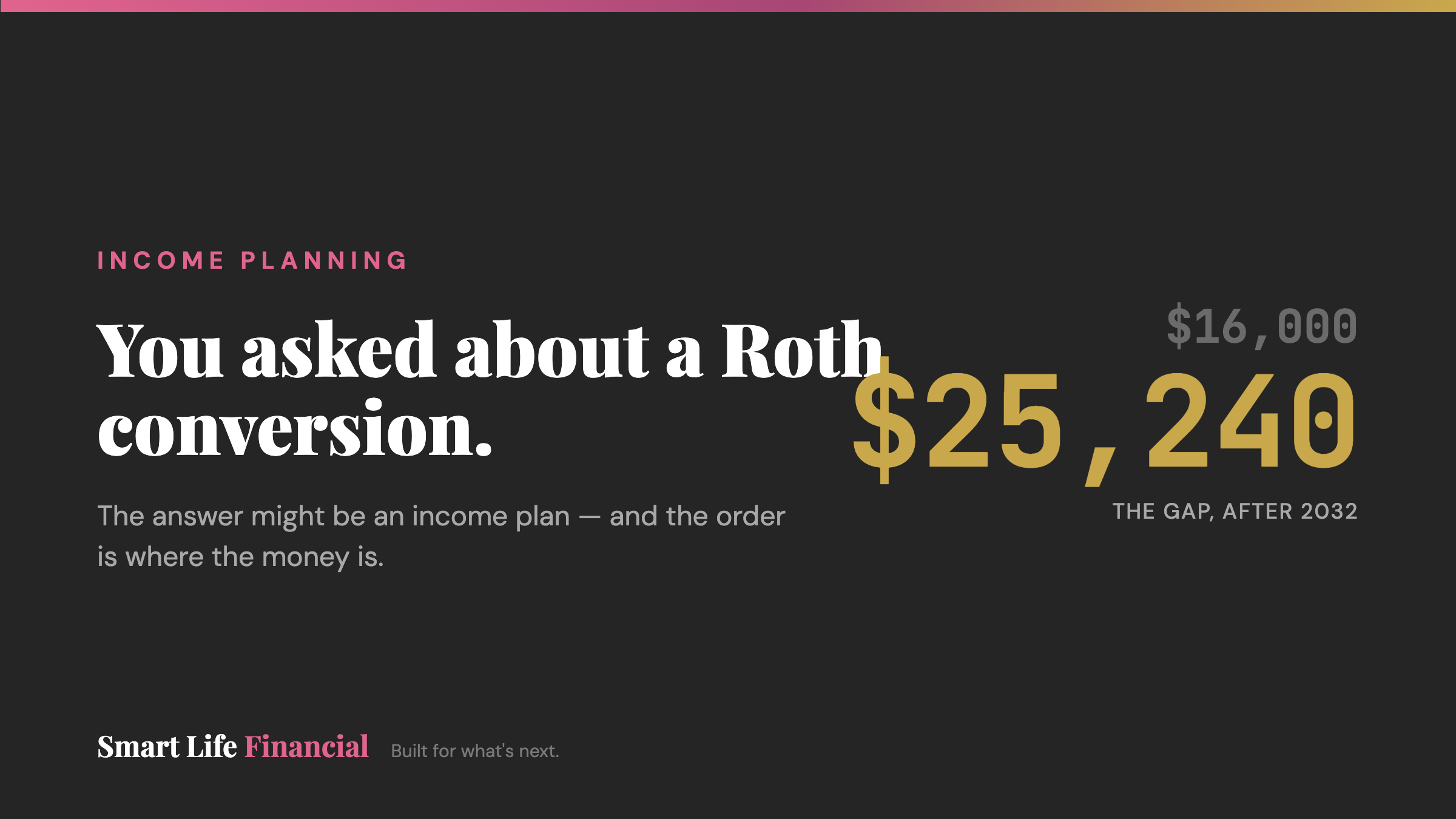
You Asked About a Roth Conversion. The Answer Might Be an Income Plan.
The call usually starts the same way — someone read about Roth conversions and calls saying they need one. Sometimes they're right. A fair number of times, the answer is an income plan, and the order is where the money is.

The Other Social Security Cut: The Tax Torpedo Explained
Social Security's taxation thresholds haven't moved since 1984. Here's how a $1,000 IRA withdrawal can cost 40.7% when your bracket says 22% — and what to do.

How a Discount Conversion Actually Works
A discount conversion is a legitimate application of ordinary valuation principles to an unusual asset — and five pressure tests that separate the real thing from the way it is often marketed.