The 2026 RMD Table: Ages 73 to 90 — What You Actually Need to Withdraw
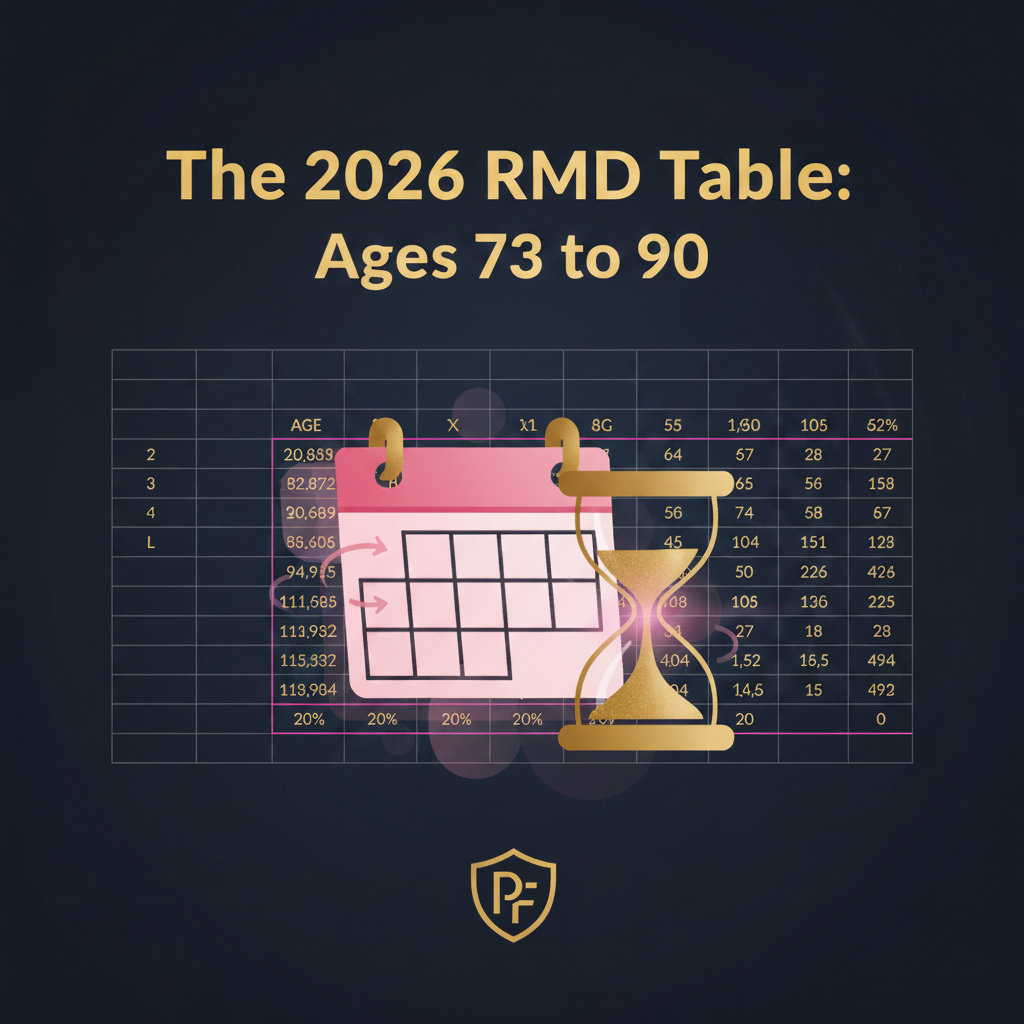
The 2026 RMD Table: Ages 73 to 90
Once you reach RMD age — 73 (born 1951–1959) or 75 (born 1960 or later) — the IRS decides how much you have to pull out of your traditional IRA or 401(k) every year, whether you need the money or not. This is called a Required Minimum Distribution, or RMD.
Miss it, and you face a 25% penalty on the amount you should have taken. Get it wrong, and you could push yourself into a higher tax bracket, trigger IRMAA Medicare surcharges, or create a larger-than-expected tax bill.
Here's exactly how it works.
How Your RMD Is Calculated
Your RMD = Prior year-end account balance ÷ IRS Life Expectancy Factor
The IRS uses what's called the Uniform Lifetime Table to assign a factor to each age. The older you get, the smaller the factor — which means the higher percentage you're required to withdraw.
The 2026 RMD Table (Ages 73–90)
| Age | IRS Factor | Approx. % to Withdraw |
|---|---|---|
| 73 | 26.5 | 3.8% |
| 74 | 25.5 | 3.9% |
| 75 | 24.6 | 4.1% |
| 76 | 23.7 | 4.2% |
| 77 | 22.9 | 4.4% |
| 78 | 22.0 | 4.5% |
| 79 | 21.1 | 4.7% |
| 80 | 20.2 | 5.0% |
| 81 | 19.4 | 5.2% |
| 82 | 18.5 | 5.4% |
| 83 | 17.7 | 5.6% |
| 84 | 16.8 | 6.0% |
| 85 | 16.0 | 6.3% |
| 86 | 15.2 | 6.6% |
| 87 | 14.4 | 6.9% |
| 88 | 13.7 | 7.3% |
| 89 | 12.9 | 7.8% |
| 90 | 12.2 | 8.2% |
Example: $800,000 IRA at age 75 → $800,000 ÷ 24.6 = $32,520 required withdrawal.
Key Rules to Know
When is your first RMD due? April 1 of the year after you turn 73. So if you turn 73 in 2026, your first RMD deadline is April 1, 2027.
Important warning: If you wait until April 1 of the following year to take your first RMD, you'll owe two RMDs in that same tax year — the one you delayed plus the one for the current year. This can significantly spike your taxable income.
Still working at 73? You may be able to delay RMDs from your current employer's 401(k) while you're still employed there — if the plan allows it and you own 5% or less of the company. IRAs get no such exception.
What if you miss an RMD? The IRS charges a 25% penalty on the shortfall. If you correct it within two years, that drops to 10%. Roth IRAs are exempt — there are no lifetime RMDs for the original owner.
Born in 1960 or later? Under SECURE 2.0, your RMD starting age is 75 instead of 73. Your first age-75 RMDs would begin in 2035 (for someone born in 1960). The factors in the table above stay the same.
The Real Problem With RMDs
Most people don't realize how quickly RMDs compound. A $1 million IRA at age 73 requires roughly $38,000 in withdrawals. By age 85, that same account (assuming growth) might require $60,000–$80,000 in withdrawals — whether you want it or not.
Those withdrawals are fully taxable. They push up your AGI. They can trigger IRMAA surcharges on Medicare. They can make more of your Social Security taxable. And they leave less for your heirs.
The best time to deal with RMDs is before they start. That means converting IRA money to Roth in the years before age 73, while you're in a lower bracket — so you control when you pay the tax, not the IRS.
Want to Know More? Here's the Truth.
If you have more than $500,000 in a traditional IRA or 401(k), you likely have a significant RMD problem building over the next 10–20 years. Most advisors don't show clients this math until it's too late to do much about it.
Scott Borhauer specializes in building pre-RMD conversion strategies that minimize lifetime taxes and give you more control over your retirement income — before the IRS takes the wheel.
Not individualized tax or financial advice. Consult a qualified tax professional for your specific situation.
About the Author
Scott Borhauer
Scott Borhauer is the founder and principal advisor of Smart Life Financial, where he designs retirement income, tax, and estate strategies for federal employees, business owners, and pre-retirees. His work centers on the arithmetic most people never get shown — Roth conversion sequencing, Social Security timing, and the tax cost of doing nothing — and he coordinates with CPAs and estate attorneys to execute the plan, not just write it. Licensed insurance producer, NPN 20016169.
Retirement Income Planning Worksheet
Step-by-step worksheet to map out your income streams and find gaps in your plan.
📊 Free instant download · Unsubscribe anytime
Related Posts
You Asked About a Roth Conversion. The Answer Might Be an Income Plan.
The call usually starts the same way — someone read about Roth conversions and calls saying they need one. Sometimes they're right. A fair number of times, the answer is an income plan, and the order is where the money is.
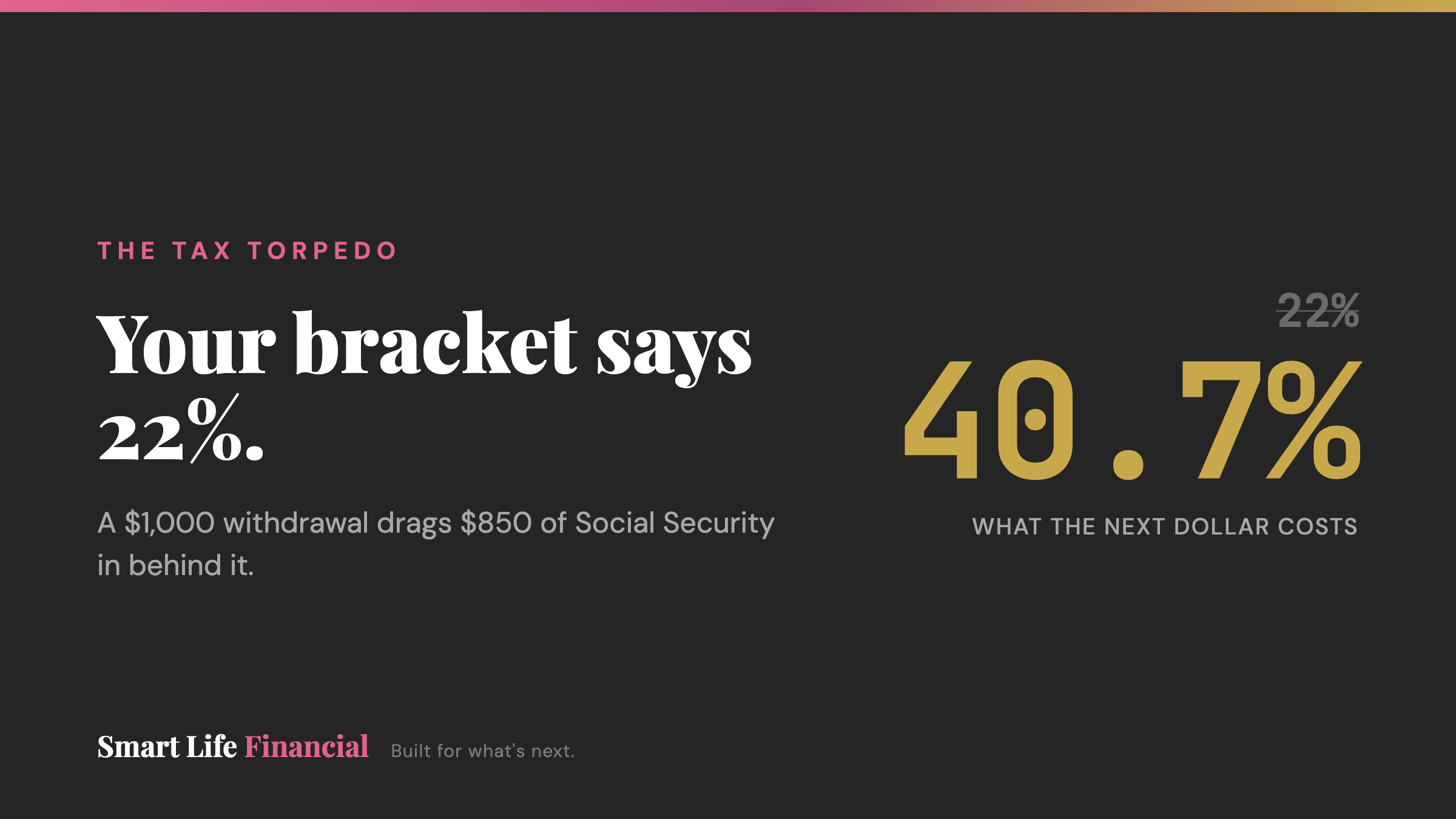
The Other Social Security Cut: The Tax Torpedo Explained
Social Security's taxation thresholds haven't moved since 1984. Here's how a $1,000 IRA withdrawal can cost 40.7% when your bracket says 22% — and what to do.
How a Discount Conversion Actually Works
A discount conversion is a legitimate application of ordinary valuation principles to an unusual asset — and five pressure tests that separate the real thing from the way it is often marketed.