A married couple, both on Medicare, reports $218,000 of income on their tax return. Their Medicare surcharge is zero. Another couple reports $218,001. Their surcharge is $2,296.80 for the year.
That is not a typo. One dollar of income, $2,296.80 in premiums. The rule behind it is called IRMAA, and if you are doing Roth conversions, or thinking about them, it is one of the most important numbers in your plan.
What IRMAA is
IRMAA stands for Income-Related Monthly Adjustment Amount. It is an extra charge on your Medicare Part B premium and your Part D drug coverage when your income is above a set level. Everyone on Part B pays the standard premium, $202.90 a month in 2026. IRMAA is added on top.
It is charged per person. If you and your spouse are both on Medicare and over the line, you both pay.
It is a cliff, not a slope
Income tax brackets are gradual. Cross into a higher bracket and only the dollars above the line are taxed at the higher rate. IRMAA works differently. Cross a line by one dollar and you pay the full surcharge for that level, every month of the year.
Here is the math on that first line for a couple:
$81.20 Part B + $14.50 Part D = $95.70 a month, per person
$95.70 × 12 months = $1,148.40 per person
$1,148.40 × 2 people = $2,296.80 a year
There are five lines. At the top level, the same couple pays $13,872 a year in surcharges.
The two-year lag
Social Security sets your premium from the tax return two years earlier. Your 2026 premiums are based on your 2024 return. A Roth conversion you do this year shows up as a Medicare bill in 2028.
The lag cuts both ways. A one-time conversion raises premiums for one year, not forever. But the lookback also starts before Medicare does. If you enroll at 65, the income you report at 63 sets your first premium. Conversions at 63 and 64 count.
Same couple, three conversions
Take a married couple, both on Medicare, with $156,200 of income. That leaves them $61,800 below the first line. Here is what three different conversions cost them in Medicare premiums.
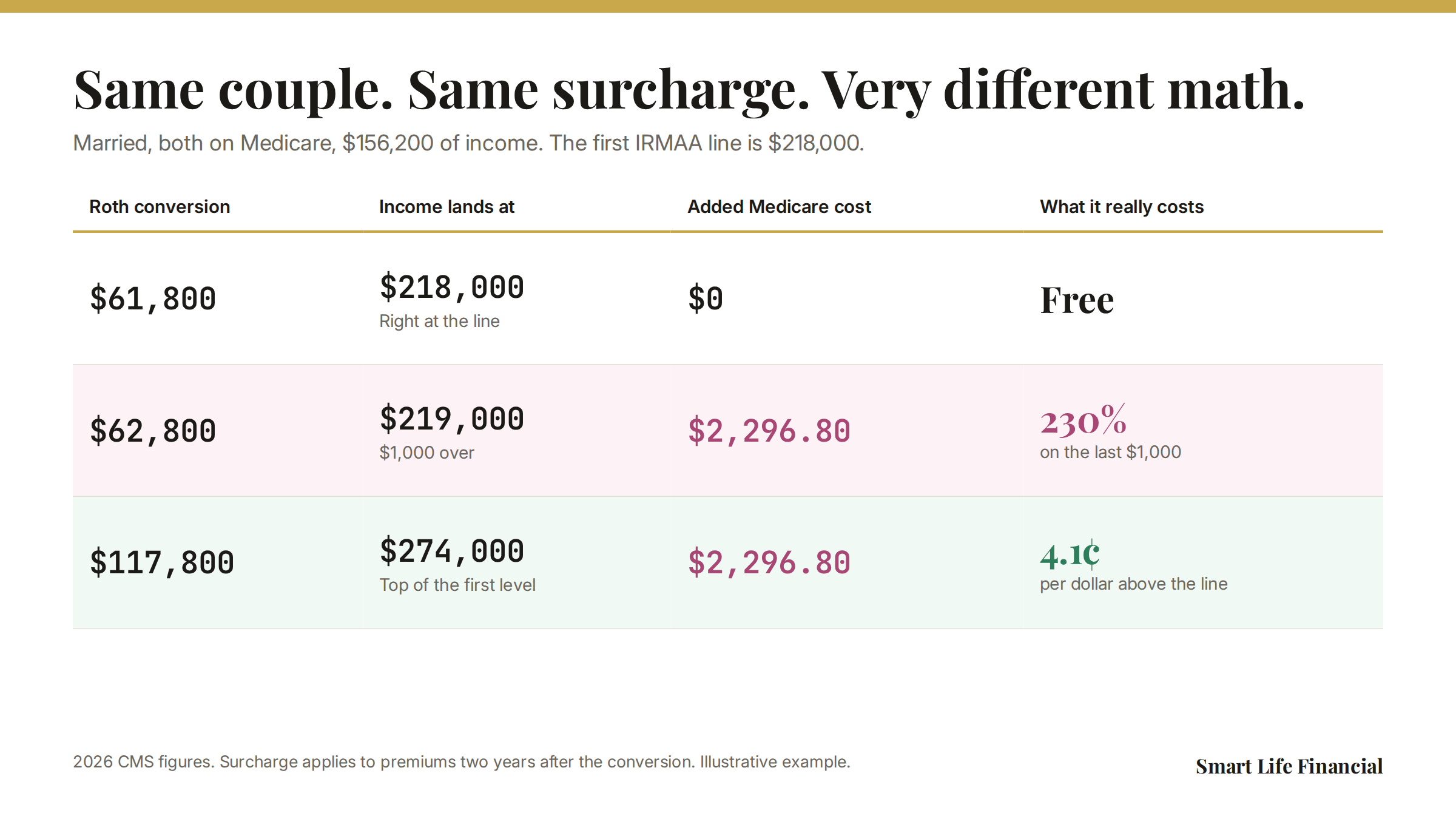
The middle row is the mistake. The couple went $1,000 over the line and paid $2,296.80 for it. That is 230% on those last dollars.
The bottom row is the same surcharge, used on purpose. They converted all the way to the top of the first level. Spread across the $56,000 they converted above the line, the surcharge works out to about 4.1 cents per dollar.
IRMAA is a cost to price, not a wall to stop at.
Whether 4.1 cents is worth paying depends on what that money would cost in taxes later. That includes the required minimum distributions that keep growing and the tax your heirs would pay. Sometimes staying under the line wins. Sometimes paying a surcharge for a year to move more into a Roth wins by a wide margin. Landing just over the line almost never wins.
Social Security can make it bigger
If you collect Social Security, up to 85% of it can become taxable, depending on your other income. A conversion can pull more of your benefit into taxable income at the same time. In one example we ran, a $10,000 conversion raised the couple’s income by $17,100. A conversion sized to stop $5,000 under a line can end up over it.
The surviving spouse squeeze
When one spouse dies, the survivor usually files as single starting the next year. The single lines are half the joint lines. Income rarely falls by half.
A couple with $150,000 of income pays no surcharge. A surviving spouse with the same $150,000 pays $2,884.80 a year. Conversions done while both spouses are alive, at the joint lines, are one of the best ways to soften this.
What to do with this
First, know your number. Find your income for IRMAA purposes: your adjusted gross income plus any tax-exempt interest. Then see how far you are from the next line.
Second, size each conversion to a line on purpose. Either stay under it with a cushion of a couple thousand dollars, or go through it and use the whole level. December dividends and fund distributions can push you over a line you thought you cleared.
Third, look ahead. Model the years when RMDs start and the year after a spouse passes, not just this year.
Run your own numbers
Our free IRMAA calculator shows where your income lands, what a conversion would add, and exactly how much room you have before the next line. It takes about two minutes.
Open the IRMAA calculator Walk through it with ScottThis article is for education only and is not tax, legal, or Medicare enrollment advice. Figures are 2026 amounts published by CMS on November 14, 2025. 2027 figures are expected in November 2026. Examples are illustrative. Actual premiums are determined by the Social Security Administration. Consult a qualified tax professional before acting.